Everyone's Talking About Sex. Is Anyone Having It?
Britain talks about sex more than ever, yet has less of it. A crisis, a choice, or a sign we're redefining what intimacy really means to us?
Siren Team
Nov 25, 2026

All Talk, No Touch
We're talking about sex more freely than ever. So why are we having less of it?
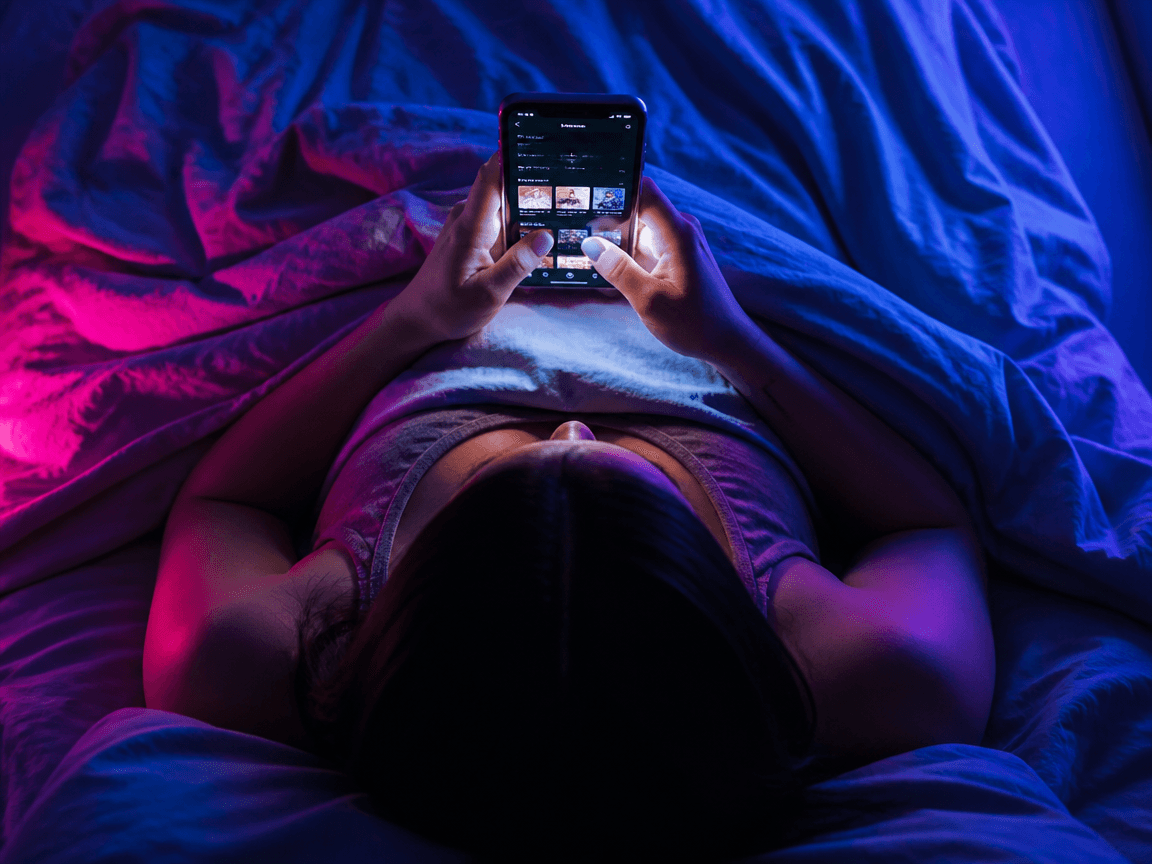
It's gone midnight. Your phone glows on the pillow, someone's voice is in your ear and a dozen strangers' fantasies are one swipe away. The other side of the bed is empty. Sex is everywhere.
It's in our music, our television, our private messages and the devices we take to bed. We have unprecedented access to other people's fantasies, entire libraries of adult content and increasingly sophisticated ways to experience intimacy without another person physically present.
And yet, somewhere between the scrolling, swiping and sexting, we appear to be having less sex.
The latest National Survey of Sexual Attitudes and Lifestyles (Natsal) reveals a fascinating contradiction in Britain's relationship with intimacy.
Approximately a third of people aged 16 to 24 report never having had sex, compared with around a fifth in the previous survey. Meanwhile, adults under 45 are having sex around twice a month, compared with once a week in 1990.
So, what's happening between the sheets?
Or, perhaps more appropriately, what isn't?
A sexually liberated but sexually inactive generation?
Previous generations fought for the freedom to talk about sex, explore their sexuality and challenge the shame surrounding desire.
Today's generation has inherited much of that freedom.
We can discuss fantasies openly, explore our preferences privately and access information about sexual pleasure without the embarrassment of asking another person.
But sexual freedom also includes the freedom not to have sex. For asexual people, for anyone choosing celibacy and for anyone simply between chapters, that isn't a loophole. It's the point.
Perhaps some people are waiting longer because they feel less pressured to participate. Greater awareness of consent, boundaries and personal autonomy may be changing the way younger generations approach intimacy. Waiting until it feels right isn't prudishness. It's judgement.
Having less sex isn't necessarily evidence that something has gone wrong.
It might, in some cases, mean that something has gone right.
Has intimacy become inconvenient?
Real intimacy requires something that digital experiences rarely demand to the same extent: vulnerability.
There is the possibility of rejection. Awkwardness. Miscommunication. The inconvenience of coordinating two people's lives, desires and expectations.
Digital pleasure, by comparison, can be accessed privately, conveniently and on our own terms.
No awkward morning after. No unanswered messages. No pretending to enjoy somebody else's taste in music.
But it would be simplistic to blame pornography or technology alone.
Interestingly, the Natsal researchers found that pornography consumption and masturbation were less common among respondents who had never had sex. This challenges the assumption that digital sexual activity is simply replacing physical intimacy.
Economic pressures, living arrangements, mental wellbeing, changing social habits and the lingering effects of the pandemic may all contribute.
Perhaps the problem isn't that we've stopped wanting intimacy.
Perhaps the circumstances in which intimacy happens have changed.
When desire goes digital
There was once a time when hearing somebody's voice meant picking up the telephone.
Now, a voice can be recorded, replayed, personalised and even artificially generated.
We can experience attraction without proximity, flirtation without meeting and emotional attachment without ever occupying the same room.
The latest Natsal survey didn't examine romantic relationships with artificial intelligence, but its researchers acknowledge that future studies may need to.
That alone tells us something about how rapidly the landscape of intimacy is evolving.
What will the next generation consider a relationship? Will emotional connection require physical presence? And how will we distinguish between feeling desired and interacting with something designed to make us feel desirable?
These are no longer entirely hypothetical questions.
Are we having less sex, or redefining intimacy?
At Siren, we are particularly interested in the relationship between imagination, sound, desire and human connection.
A voice can create a sense of closeness. Close your eyes and your imagination quietly furnishes the rest: the room, the light, the person speaking. A story can awaken curiosity. A fictional encounter can evoke genuine emotions. The feelings are real, but the encounter is a space you can leave whenever you like, and that is exactly what makes it safe to explore.
But these experiences don't necessarily have to replace physical intimacy. They can exist alongside it, encouraging self-discovery, communication and a greater understanding of what we enjoy.
Perhaps measuring how frequently people have sex tells us only part of the story.
It doesn't tell us whether they're satisfied, whether they feel connected, whether they're lonely or whether they're simply comfortable with their own company.
More sex doesn't automatically mean more happiness.
Less sex doesn't automatically mean less desire.
What matters is whether the intimacy we experience, in whatever form it takes, is meaningful to us.
And perhaps the most interesting question isn't whether we're having enough sex.
It's whether we're having the kind of intimacy we actually want. Frequency is a number. Satisfaction is a story.
A Curious Thought by Siren Audio Stories.
Inspired by findings from the fourth National Survey of Sexual Attitudes and Lifestyles (Natsal-4), as reported by Michelle Roberts, BBC Digital Health Editor.
Tags: